
Advanced Dynamic Mixed Decay (ADMD) Technology
Advanced Dynamic Mixed Decay (ADMD): Smoother, Quieter Motor Control
ADMD technology tracks the target current more closely than conventional mixed-decay control, which makes efficient, smooth motor control possible even at high speeds (rpm).
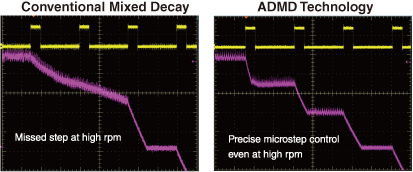
The ADMD current waveform follows the ideal curve more closely than conventional mixed decay.
The background
A stepper motor driver controls the motor’s torque by controlling the electric current in each motor winding. In microstepping, the driver tries to make that current follow a smooth, wave-like curve (a sine wave). To do this, it switches the voltage on and off very rapidly to keep the current close to a target value.
When the current needs to fall, the driver must decide how quickly to let it drop. This choice is called the decay mode:
- Slow decay: the current drops gradually. This is smooth with little ripple, but it can’t keep up with a quickly falling target, so the current overshoots.
- Fast decay: the current drops quickly and tracks the target well, but it creates more ripple, noise, and wasted power.
- Mixed decay: a blend of the two, using a fixed ratio chosen by the designer.
The problem with a fixed ratio
No single fixed ratio works well in every situation. The current is rising on one part of the wave and falling on another, and the best setting changes with the motor’s speed, the supply voltage, and the electrical voltage the spinning motor generates (called back-EMF). With a fixed ratio, the current waveform becomes distorted at some speeds, and you notice it as vibration, audible noise, and rougher motion.
How ADMD solves it
ADMD lets the driver choose the decay setting on its own, in real time. It compares the actual current to the target and adjusts the decay behavior to match, with no manual tuning.
What this means for you
- More accurate current. The motor current follows the ideal curve more closely.
- Less vibration and noise. Cleaner current means smoother, quieter operation.
- Consistent performance. Motion stays smooth across a wide range of speeds and loads, including high speeds.
- No manual tuning. The driver adapts itself, so there is no need to adjust a decay setting for each motor or operating condition.
This makes ADMD especially valuable in applications where smooth, quiet motion matters, such as precision positioning.
ADMD and AGC working together
ADMD and AGC work as a team. ADMD makes the current waveform smoother and quieter, while AGC makes sure the current level is only as high as the load requires. The CMD-4EX-SA-TBD and CMD-2ED-SA controllers include both.